The translation itself took minutes. Verifying it found a bug that had been sitting in my app all along — in English too.
Why bother
While researching where local AI inference is actually popular, I kept running into the same answer: China. It makes sense — capable consumer GPUs, a strong self-hosting culture, a healthy distrust of cloud services. It’s also a market that’s structurally out of reach for Western cloud SaaS… but not for an open-source desktop app. Nothing to host, nothing to bill, nothing to block.
So the math looked like this: potential upside — access to one of the largest local-inference communities in the world; cost — an afternoon. I don’t speak a word of Chinese. I did it anyway.
Imference Desktop is a local-first image generation app. There isn’t that much text in it — buttons, labels, settings, error messages. I asked Claude to translate the locale file. That’s the part everyone imagines is hard. It isn’t.
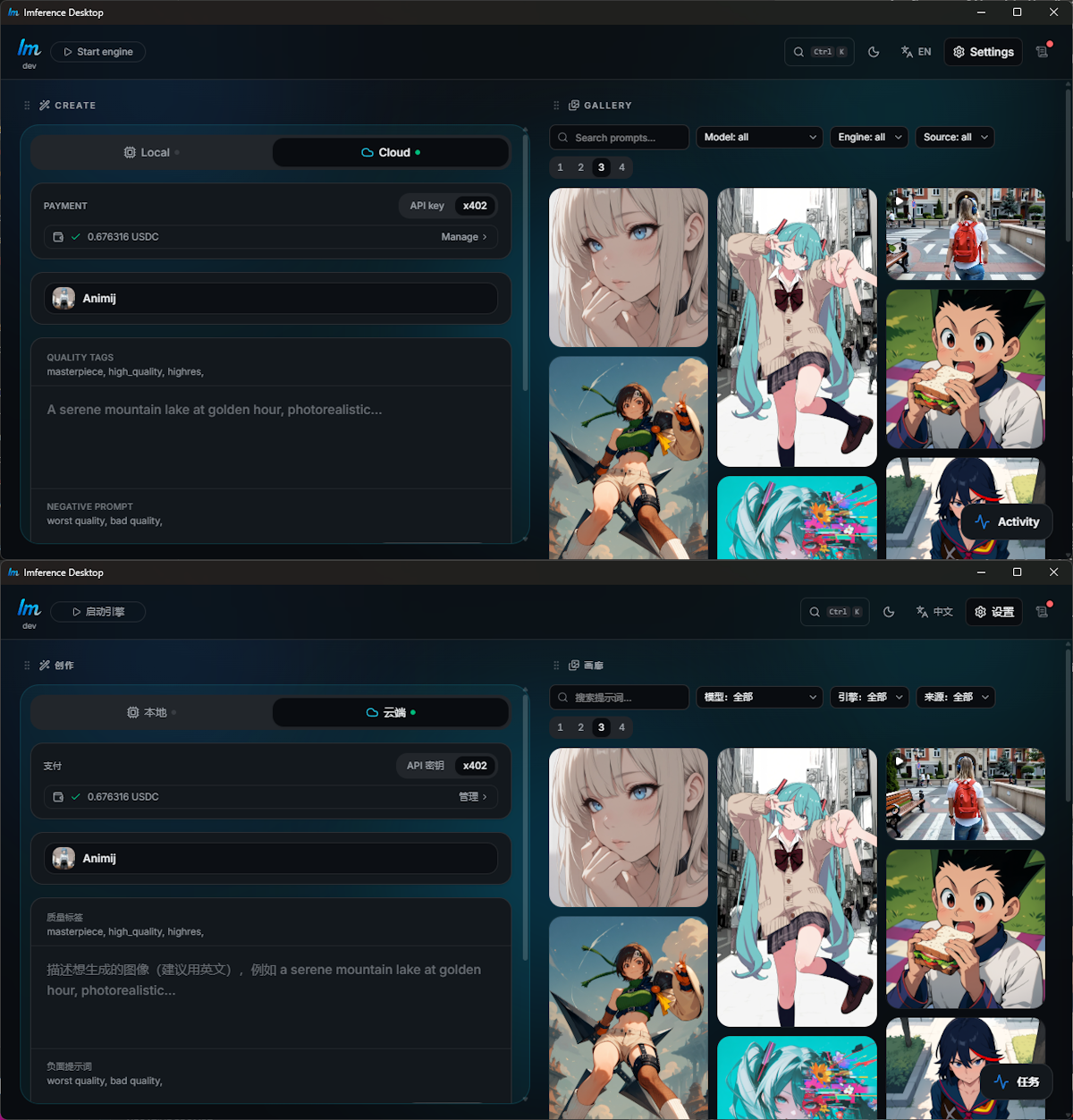
 Same screen, two audiences — English on top, Chinese below.
The parts that actually needed thought
Some strings don’t live where you think they do. My format labels (“Portrait Large”, “Landscape Ultra-Wide”…) come from the server’s model catalog, not from the app’s locale files. Result: the format bar showed up half-translated — three Chinese labels followed by six English ones — because only the strings that existed as i18n keys got translated. Localization coverage is an architecture question before it’s a language question.
Some things must NOT be translated. Model names stay in English — even Chinese users say “Flux” and “SDXL”. Translating them would have made the app harder to use. Knowing what to leave alone matters as much as translating the rest.
Localization is adaptation, not conversion. The Chinese prompt placeholder doesn’t say what the English one says. It adds a piece of advice the English version doesn’t need: “describe the image you want (English recommended), e.g. …”. Most image models are trained predominantly on English captions; a Chinese user typing a Chinese prompt gets worse results through no fault of their own. The translation that serves the user diverges from the source on purpose.
Verifying what you can’t read
Here’s the uncomfortable part. When the translation came back, I was looking at strings I could not evaluate at all. For all I knew, my “Cancel” button said something embarrassing.
My review pipeline, fully honest version:
- I took paired screenshots of every screen — English and Chinese side by side.
- I fed them to a fresh Claude session, in incognito mode, with no memory of my app and no stake in defending its own translation, and asked for an element-by-element comparison.
- It came back with a structured review: most of the translation judged idiomatic and faithful, the half-translated format bar flagged, two wording refinements suggested (a clearer per-generation credits label, a VRAM-vs-memory inconsistency in a settings subtitle), and one question — “your Chinese placeholder diverges from the English one, is that intentional?”
- I fed that review to Claude Code, which traced each finding to the actual cause in the codebase and implemented the fixes.
My job in all this was arbitration, not translation: keep the divergent placeholder (intentional), pick the Chinese naming scheme for the extended formats, decide where to fix what. The pipeline was AI end to end — translator, reviewer, implementer — with a human making the three or four judgment calls that actually required one.
The review found a bug in my app
This is the part I didn’t see coming. Comparing the two languages element by element, the reviewer noticed something off that had nothing to do with Chinese: my aspect ratios were backwards. A 896×1152 portrait format was labeled “9:7” — a landscape ratio. Checked against the API: systematic, every image format in the catalog ships its ratio string inverted. In production. In both languages. Nobody had ever reported it — including me, who had looked at that format bar hundreds of times.
The fix was a ten-line client-side normalization (trust the dimensions, flip the string when its orientation disagrees). The lesson is bigger: a careful localization review is a free QA pass. Fresh eyes — even artificial ones — forced to compare two renderings of the same UI element by element will catch things you’ve stopped seeing. The Chinese translation improved my English app.
What I’d tell other indie devs
AI has collapsed the cost of localization. What used to require an agency, a budget and weeks now takes an afternoon — for the right kind of product. Two honest caveats:
- This works because my app has little text and low stakes. I would not ship an AI-only translation for legal copy, medical content, or marketing where tone is everything.
- The translation is the cheap part. The verification pipeline and the public honesty are what make it shippable. My Chinese README says it plainly: translated with AI assistance by a dev who doesn’t speak Chinese — corrections welcome via PR. That one line turns my biggest weakness into a contribution funnel.
The asymmetry is what matters: an afternoon of work for access to a market I couldn’t otherwise touch. Even if it only ever brings a handful of users and a few translation-fixing PRs, it already paid for itself — it found a bug my own eyes never would have.